
Blog

June 29, 2026

Annie Shrewsbury, of FFT Chartered Accountants in Manchester, has warned of the increasing prevalence of AI in client filings and is concerned about the risks it poses.
Her fundamental fear is the number of re-filings that business owners may need to perform as AI hallucinates answers to questions it doesn’t understand.
Annie explains that while ChatGPT, Co-pilot, and AI features within cloud accounting software are useful, they all require careful factchecking.
“You can’t rely on them or just go with whatever they say,” she says.
Even small errors, she points out, can quickly escalate.
“A misfiled transaction compounds across filings and statutory returns, creating a domino effect that could take weeks to resolve,” she explains.
Within her client portfolio, Annie has noticed a marked increase in AI-generated content.
Other company secretarial experts have reported the same trend, highlighting that this is far from isolated.
Clients are using AI to save time and cut costs, often without fully appreciating the consequences.
As Annie observes, “it’s so easy to spot when a client has used ChatGPT and I think it’s totally understandable. They’re looking to save time, money, etc.
“However, I think they underestimate the nuance required in company filings. AI can draft resolutions or populate forms, but it can’t understand context, prior decisions, or the specific legal framework of a company.”
According to Annie, “the risk of needing to re-file and making mistakes far outweighs the costs saved or the time not spent doing it properly.”
Her concerns are especially acute in bookkeeping.
Auto-reconcile features in cloud accounting tools use AI to fill gaps, but mistakes are inevitable.
“Clients often assume that automation guarantees accuracy, when in reality AI can’t determine if a transaction should be capitalised, expensed, or how it impacts your tax obligations.”
She believes that AI has impacted the ability of companies to correctly file accounts on time and accurately and the trend on the statistics here supports her assertion:
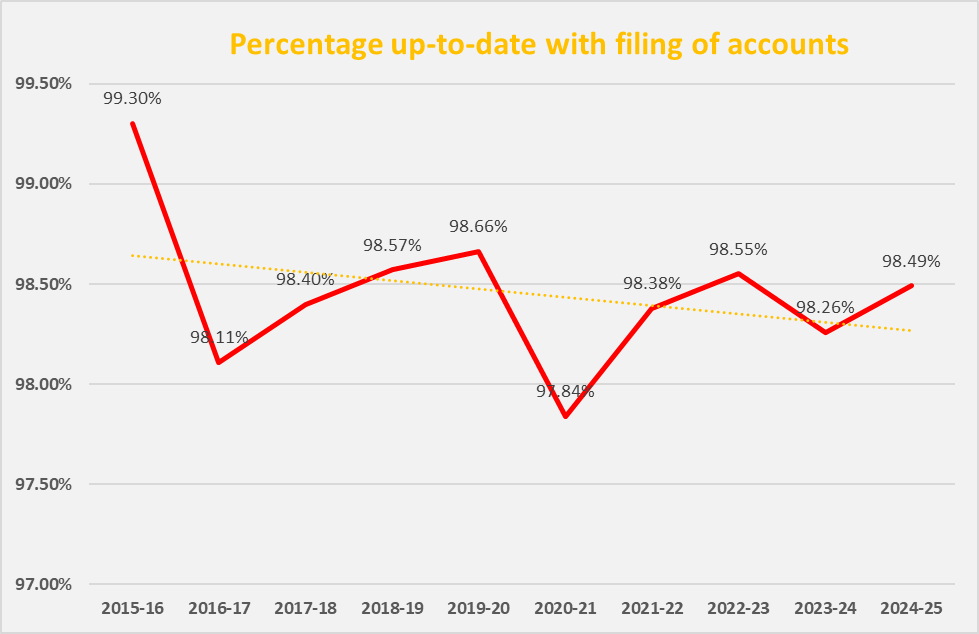
*Statistics taken from Companies House Management Information April 2024 to March 2025 accurate as of June 2026.
Annie explains that these errors create additional work for accountants, who must sift through a year’s worth of filings to verify data and correct AI hallucinations.
“A lot of clients think they don’t need to worry about putting things in the right places but it’s going to cost them so much more,” she says.
Even seemingly minor mistakes can have wide-reaching implications, affecting statutory obligations, Companies House filings, VAT returns, and potentially triggering fines.
Looking ahead, Annie warns that as AI becomes more integrated into accounting, the likelihood of re-filings, amendments, and avoidable stress will grow.
To speak to our FFT about your filings, please contact our Manchester office.


Freedman Frankl & Taylor is the trading name of FFT Limited.
Registered in England and Wales, Company number: 04510195
Registered to carry on audit work in the UK and regulated for a range of investment business activities by the Institute of Chartered Accountants in England and Wales
Manchester Accountants
A list of connected firms is available upon request at our registered office.